Private toll road with ANPR: A guide to setup, financing and operations
At Hi Tech we deliver ANPR solutions for private toll roads. This technology enables private road owners to charge for passages and secure contributions toward maintenance. In this article we walk through what it takes to establish a private toll road, formal requirements, costs and financing options, challenges of outsourcing to professional operators, benefits of using established system providers and some key figures from other private toll roads.
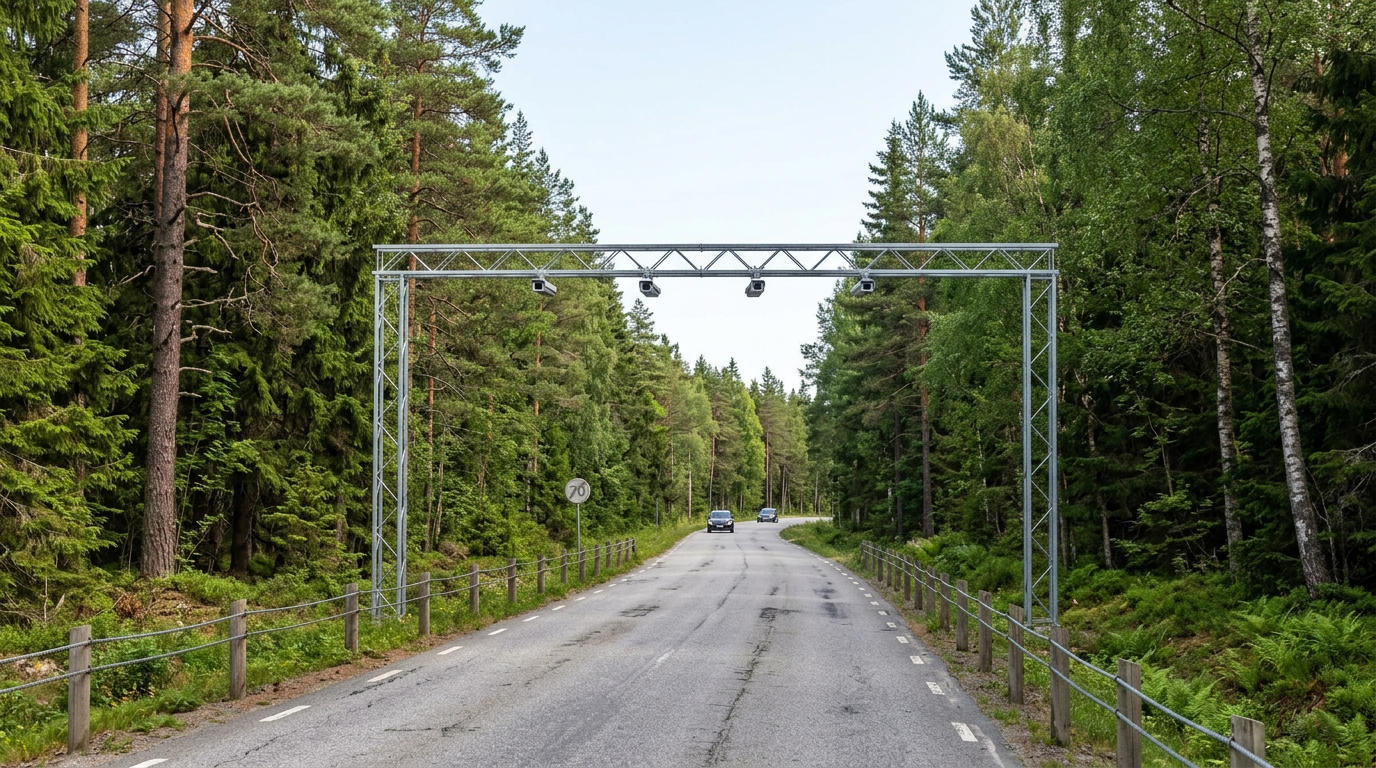
What is required to establish a private toll road
Establishing a private toll road requires:
- Formal permission – Requires consent from authorities and permission from the municipality.
- Technical infrastructure – Modern ANPR cameras, data collection, signage and connection to an invoicing and payment platform (often tied to the national AutoPASS regime).
- Registration and payment system – Users must register and receive a toll tag or be identified via ANPR for invoicing based on license plate.
- Maintenance and financing – A clear plan for operation and maintenance with an associated financing model, including cost estimates and potential investments.
Formal permits
Legal basis
The Norwegian Road Act §56 grants road owners or road associations the right to charge for use of private roads – but only with municipal consent. This means you must own or operate the road, the road must be private (not municipal or county), and users must have a genuine choice about using the road.
Municipal approval
An application must be submitted to the municipality with necessary information. The application should include a detailed description of the road (length, structures like bridges, toll stations, etc.), who is responsible (owner or road association), how the road is used, who uses it, preferably statistics on the number of passages, and financial information for the last three years so it can be verified that toll funds are used only for operation and maintenance.
The municipality's role
The municipality assesses the application and decides whether it is reasonable to charge tolls based on alternative measures, such as denying access to non-paying users. The municipality determines whether tolls can be charged, the fee level, any additional charges for non-payment, and conditions for how revenues shall be used (e.g. for operation, maintenance or safety). The municipality may also reject the application, especially if the road receives subsidies or toll collection is deemed unsuitable.
Decisions and appeals
The municipality shall process the case as quickly as possible, normally within one month or provide written notice of delay and expected decision date. Decisions must be substantiated, and if dissatisfied one may appeal within three weeks of receipt. The municipality may forward the decision to its own appeals board if the original decision is upheld.
Practical considerations in the application process
The road must be clearly private, with formal ownership. The purpose of toll collection shall be cost sharing for operation and maintenance – not for profit. Signage and information about prices, contact info and payment terms must be clear to users. Like categories of vehicles must be treated equally in the pricing structure, and any surcharges must be regulated. Access for emergency vehicles should be ensured.
Tips for a good application
- Develop a solid basis for the application with usage patterns and traffic data.
- Attach financial documentation showing previous expenses and maintenance needs.
- Formulate a detailed budget showing planned use of toll revenues.
- Ensure ongoing dialogue with the municipality to reduce resistance and promote understanding.

Costs
ANPR infrastructure
- Investment per lane: A single-lane solution typically costs around NOK 100,000 including camera, controller and basic installation. Multi-lane setups with entry and exit cameras range from NOK 200,000–400,000 depending on complexity.
- Camera variations: Dedicated ANPR cameras (with built-in OCR engine, IR lights) cost NOK 43,000–72,000 per unit, but eliminate the need for a separate server. Standard IP/CCTV cameras can be purchased for NOK 11,500–21,500, with additional OCR license costs (NOK 7,200–17,200/year).
- Ongoing costs: Cloud hosting can cost NOK 430–1,150 per month. Maintenance and support agreements range from NOK 7,200–21,500 per year. Other operating costs include electricity, internet and general IT costs.
Operating and maintenance costs
- Operational costs: Studies show that operating costs for electronic toll stations account for around 5–20% of annual toll revenue. This includes customer service staff, finance and accounting, facility monitoring and troubleshooting.
- Road maintenance: For paved roads, repairs or surface treatment is recommended approximately every 8 years, for gravel roads approximately every 3 years. Unexpected maintenance (such as damage repairs or climate-related damage) must also be budgeted, often using a reserve or contingency.

Financing
Project financing
Private toll road projects combine equity and debt so that future toll revenues secure the loan. Typical structures have 70–80% debt from banks or institutional lenders, and 20–30% equity from owners/road associations. Risk is distributed in agreements regarding traffic uncertainty, revenue uncertainty, inflation, maintenance and construction.
Revenue sources
Direct user payments, availability payments from authorities, minimum revenue guarantees or revenue sharing with the public sector. Public guarantees can improve financeability for private projects by reducing risk for investors.
International case: Panama
An example from Panama shows a 30-year Build–Own–Transfer contract for a new motorway. The private party finances construction with debt and equity, operates the road for 30 years with toll revenues, and ultimately transfers the road to the authorities. The target was to give investors an IRR of approximately 15%.
Norwegian conditions
In Norway, tolls are in practice collected through AutoPASS, combining ANPR and a DSRC tag. For a private road association this means the collection technology is already familiar to drivers – the challenge lies in the legal basis for charging, in signage, and in who owns the customer relationship with the person passing. Up-to-date figures on scope and revenue are available from the Norwegian Public Roads Administration.
Private toll companies are established as limited companies with the purpose of raising capital for road construction and financing operations. The National Road Directorate plans and regulates projects, and Parliament makes final investment decisions. Public and private actors collaborate on some projects, while three pilot PPP projects are under consideration.
Economic conditions and key figures
Revenue sources and costs
Private financing is based on the user-pay model, where those driving on the road pay tolls as a direct contribution to development and maintenance. Project economics depend heavily on traffic volume, price levels, investment costs and operating expenses, which must be modeled realistically to ensure project viability.
Risk and financing
Private actors bear the greatest risks, including uncertainty related to traffic (figures may be overestimated) and revenue development, interest and currency conditions, political decisions, and regulatory changes. Public-private partnerships (PPP) or project financing with loans from banks and institutional investors are often used. Government support such as guarantees, minimum revenue guarantees or availability payments help reduce uncertainty and increase financeability.
Example projects
International studies of eight private toll road projects illustrate that models vary greatly, but success depends on balanced risk sharing, realistic traffic assumptions, robust financing structures and favorable concession climate. Key lessons are that economics vary with facility type and market, that authorities often must assume risks related to property, political risk or traffic guarantees, and that financing typically comes from bank loans and equity while access to public capital markets is limited.
Norway in brief
Tolls are an established part of Norwegian road financing, and collection happens mainly through AutoPASS using ANPR and tags. There are few up-to-date public figures for private road associations specifically, so use the Norwegian Public Roads Administration and your own association's accounts as the source when costing a concrete project. We expect moderate growth in private toll roads – the constraint is rarely the technology, but the concession process, local opposition and the time before collection can begin.
Challenges of outsourcing to professional operators
- Dependency risk: Ties to a single supplier can create dependency, and switching systems when upgrades or strategy changes are needed can be challenging. Closed systems and proprietary solutions make interoperability difficult and can lock in the customer.
- Scalability and customization: Vendor solutions can be inflexible regarding local customization or changes in user base or regulations. When traffic patterns change or new functionality needs to be implemented, it may require costly modifications or complete replacement.
- Costs and contract management: Vendors often require fixed operating fees, installation costs, support fees and potential upgrade costs. Contracts must be designed to ensure transparency, favorable amendment terms, avoid hidden costs and protect customer rights in case of default.
Benefits of using an established system provider
- Rapid implementation: Ready-made solutions dramatically reduce development and implementation time compared to custom systems, so the toll road can be put into operation faster and with fewer errors.
- High technical quality: Supplier experience with operation, maintenance, security and uptime ensures stability and robustness, with extensive testing and continuous platform improvement.
- Integration with national systems: The national AutoPASS regime enables data and invoice integration so private toll roads are captured within existing infrastructure. Users can use tags or accounts they already have, significantly simplifying the user experience.
- Event and data management: Providers offer operational monitoring, data analysis and regulatory support. Data from ANPR can be analyzed for better traffic analysis, pricing strategy, compliance reporting and continuous service improvement.
What can other private toll roads teach us?
Experience from barrier-free Multi-Lane Free Flow installations is unambiguous on one point: when cars don't have to stop, the queue at the collection point disappears, and capacity is limited by the road rather than the barrier. This is also where most of the running costs sit – not in the cameras, but in following up the passages the system cannot match to a paying owner.
Before you model revenue, ask two questions: how many passages does the road have today, and what share of them can actually be invoiced? The first can be counted with a short measurement period, the second depends on signage, legal basis and how many of the vehicles are registered in Norway. Both figures belong in a concrete budget before the first camera is ordered.
Summary
Private toll roads with ANPR technology offer significant advantages through efficient and barrier-free collection, lower operating costs than manual systems, data-driven decision support for pricing and traffic regulation, and simplified user experience. Challenges such as vendor dependency, technological scalability and economic risk must be addressed through good contracts, clear risk-sharing models and thorough financial modeling. With competent system providers, fully integrated solutions and solid planning, private road owners have a strong foundation for profitability and public benefit – economically, environmentally and in infrastructure development.
Sources
- AutoPASS – rules and practice for ANPR-based collection in Norway
- PPIAF & World Bank – Private Financing of Toll Roads
- Norwegian Public Roads Administration – statistics on toll collection and the AutoPASS network
- Privatvei.no, Ringebu kommune, Midtre Gauldal kommune, Bergen Huseierforening – regulations and application process for tolls on private roads
- Our own project experience – cost level for ANPR installations (2026)
- Odeck & Bråthen (2006) – Funding of Road Construction in Norway
Want to know more about our solution for private toll roads?
Read about our industry solution for private toll roads →Ready to digitize your toll road?
Get in touch for a no-obligation conversation about how ANPR can streamline your private toll road.
Contact us